
Run Snapshot
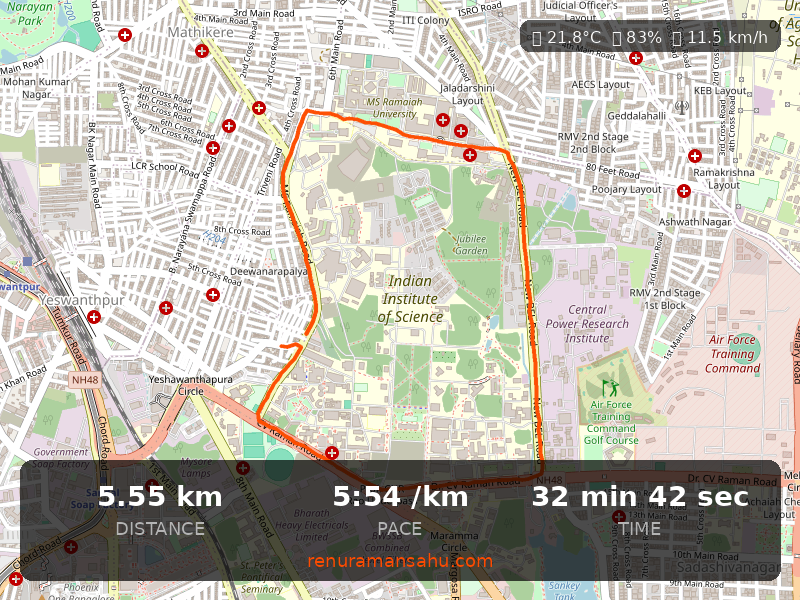
Raman covered 5.55 km at a 5:54/km pace, taking 32.7 minutes to complete the run. The morning run started at 06:39 AM IST, with a temperature of 21.8°C, humidity at 83%, and an Air Quality Index (AQI) of 50, indicating good air quality.

Pace & Effort Breakdown
The gap between Raman’s average pace of 5:54/km and maximum pace of 3:18/km reveals a pacing strategy that allowed for significant variability. Given the average cadence of 81.1 spm, Raman’s form efficiency is below the optimal range of 170-185 spm, suggesting room for improvement. With a temperature of 21.8°C, which is above 20°C, we can expect a pace slowdown of around 2-5% per 5°C above 20°C. The dew point of 18.8°C may have had a minor impact on evaporative cooling and breathing. The AQI of 50 (estimated from atmospheric model) indicates a negligible effect on performance, making it ideal for hard efforts. The PM2.5 level of 6.9 µg/m³ is within safe limits, posing no significant risk to airways.
Route Narrative
The run began with a 6:19/km pace on the first kilometer, with an elevation gain of 0.7m. On the second kilometer, Raman picked up the pace to 5:22/km, despite a 7.0m elevation loss. The third kilometer saw a pace of 6:09/km, with a 3.7m elevation gain. The pace remained consistent on the fourth kilometer, with a 6:09/km pace and a 13.9m elevation gain. The fifth kilometer had a pace of 6:33/km, with a 3.6m elevation loss, while the sixth kilometer had a pace of 6:02/km, with a 4.9m elevation loss. The fastest segment was the second kilometer, with a pace of 5:22/km, likely due to the downhill terrain. The slowest segment was the first kilometer, with a pace of 6:19/km, possibly due to a cautious start. Raman’s cadence remained relatively consistent, ranging from 160 to 164 spm throughout the run.
Run Analysis
Workload Intelligence
The Acute-to-Chronic Workload Ratio (ACWR) is 2.38, which falls into the danger zone, indicating a high injury risk. The acute load of 110.8 over the past 7 days is significantly higher than the chronic load of 46.6. With 4 runs in the past 7 days and 8 runs in the past 28 days, Raman's weekly run count and distance trends suggest a high training load. At an ACWR of 2.38, the acute load of 110.8 sits above the chronic baseline of 46.6, indicating a need to reduce the training load to avoid injury.

Physiological Impact
Given the pace of 5:54/km and duration of 32.7 minutes, this session likely targeted the aerobic energy system. This session drives adaptations such as increased mitochondrial density, capillarization, and lactate clearance. With an AQI of 50, there is no added respiratory stress. The average cadence of 81.1 spm and pace of 5:54/km suggest a moderate-intensity effort, which is consistent with the expected physiological adaptations.
Recovery & Next Session
Based on the high ACWR of 2.38 and the significant gap between acute and chronic loads, Raman should take at least 48 hours of recovery before the next intense workout. The next workout should be a low-intensity, 30-40 minute easy run at a pace of 6:30-7:00/km, allowing for active recovery and a reduction in training load.
Training Trajectory
The 28-day volume trend suggests a need to reduce the training load to avoid injury. Over the next 1-2 weeks, Raman should aim to reduce the ACWR to below 1.5 by decreasing the acute load and increasing the chronic load. A concrete coaching directive would be to target a weekly distance of 20-25 km, with a maximum of 3 runs per week, and a pace range of 6:00-6:30/km for moderate-intensity workouts.
View the original activity on Strava
Gear Used: Asics Novoblast 5 (Shoes)
Transparency: The links above are affiliate links — if you purchase through them, I earn a small commission at no extra cost to you. It helps support my training and this data analysis hobby project.