
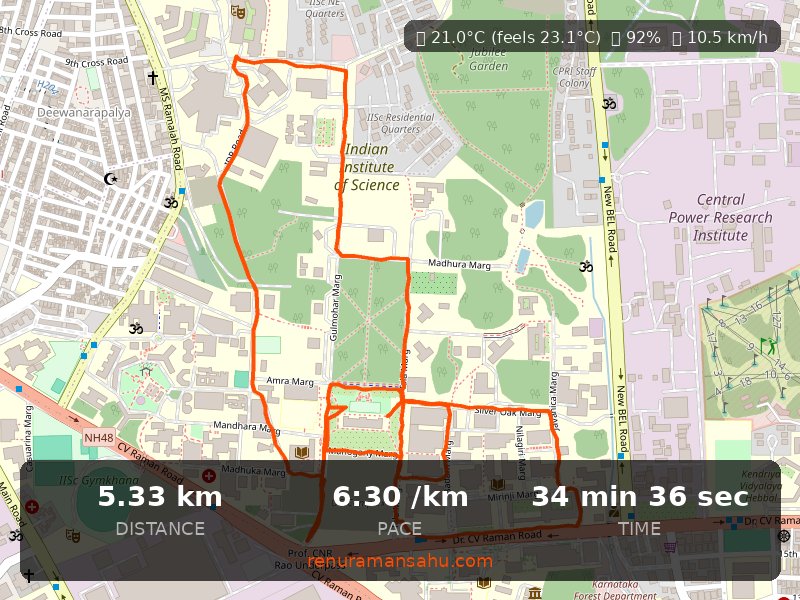
Run Snapshot
Raman covered 5.33 km at a 6:30/km pace, taking 34.6 minutes of moving time on a morning with 21.0°C temperature and 92% humidity. The elapsed time was 38.9 minutes, including 4.2 minutes of stopped time. Heart rate data was not available for this session.
Pace & Effort Breakdown
The gap between Raman’s average pace of 6:30/km and max pace of 1:41/km reveals a pacing strategy that likely involved a sprint or a short, all-out effort. Without heart rate data, an effort-to-pace ratio cannot be computed. Raman’s average cadence was 78.2 spm, which is below the optimal range of 170-185 spm, suggesting room for improvement in form efficiency. Given the temperature of 21.0°C, a pace slowdown of around 2-5% can be expected compared to cooler conditions. The dew point of 19.6°C may have had a minor impact on evaporative cooling and breathing.
Route Narrative
Raman’s run began with a slow first kilometer, averaging 8:55/km as he descended 6.6 meters. The pace improved significantly in the second kilometer, with an average of 7:31/km as he climbed 3.4 meters. The third kilometer was the fastest, with an average pace of 6:10/km as Raman descended 4.5 meters. The pace remained relatively consistent over the next two kilometers, with averages of 6:20/km and 6:07/km, respectively. The final segment, however, saw a slight slowdown, with an average pace of 6:35/km as Raman descended 1.5 meters. The fastest segment was the third kilometer, likely due to the downhill terrain, while the slowest was the first kilometer, possibly due to a gradual warm-up.
Elevation Profile
Pace Analysis
Workload Intelligence
The ACWR value of 2.06 falls into the danger zone, indicating a high injury risk. The acute load of 80.0 over the past 7 days is significantly higher than the chronic load of 38.9, which is the weekly average. At an ACWR of 2.06, the acute load of 80.0 sits above the chronic baseline of 38.9, suggesting that Raman's recent training has been excessively stressful. With 3 runs in the past 7 days and a total distance of 14.4 km, Raman's weekly run count and distance trends are relatively low, which may not be sufficient to support the current level of intensity.

Physiological Impact
Based on the pace and duration of the run, it appears that Raman targeted his aerobic system, with an average pace of 6:30/km suggesting a moderate-intensity effort. This session likely drove adaptations such as improved mitochondrial density, enhanced capillarization, and increased lactate clearance. The lack of heart rate data limits the precision of these claims, but the pace and duration suggest a moderately stressful session that would stimulate aerobic adaptations.
Recovery & Next Session
Given the high ACWR value and the danger zone classification, Raman should prioritize recovery and aim for a minimum of 48 hours of rest or low-intensity activity before the next intense session. A suitable next workout could be a low-intensity, 30-40 minute easy run at a pace range of 7:00-7:30/km, focusing on active recovery and reducing the risk of injury. This prescription is based on the need to reduce the acute load and allow for adaptation to the recent stressful training.
Training Trajectory
The 28-day volume trend shows a relatively low total distance of 27.9 km, which may not be sufficient to support long-term progression. To reduce the injury risk and promote safe progression, Raman should aim to reduce the ACWR value to within the optimal range of 0.8-1.3. A concrete coaching directive would be to target a weekly distance of 30-35 km over the next two weeks, with a maximum of 3-4 runs per week, and to prioritize low-intensity, easy runs to reduce the acute load and allow for adaptation.
View the original activity on Strava