
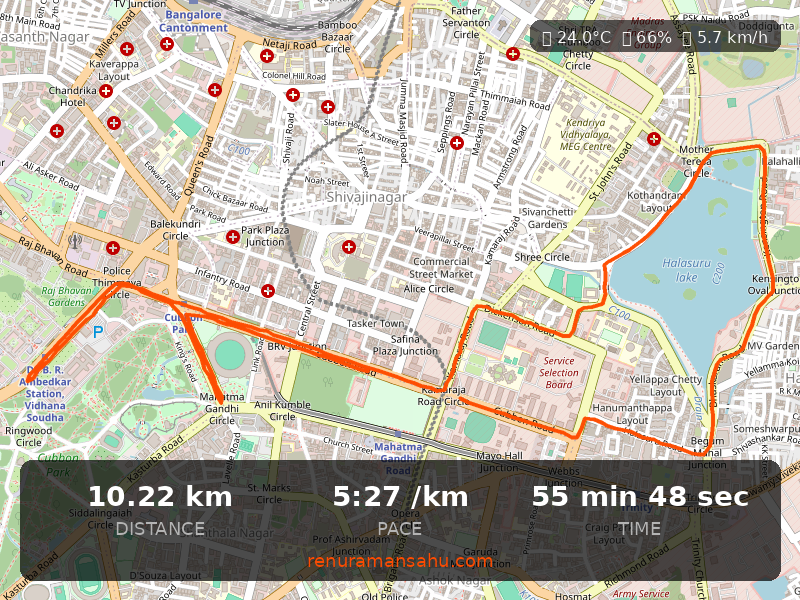
Run Snapshot
Raman covered 10.22 km at an average pace of 5:27/km, taking 55.8 minutes to complete the run. The activity took place in the morning, with a temperature of 24.0°C and humidity of 66%. No heart rate data is available for this session.
Pace & Effort Breakdown
The gap between the average pace of 5:27/km and the max pace of 2:59/km reveals a pacing strategy that allowed for significant variation in speed. Since no heart rate data is available, an effort-to-pace ratio cannot be computed. The average cadence of 82.5 spm is below the optimal range of 170-185 spm, indicating potential for improvement in form efficiency. Given the temperature of 24.0°C, a pace slowdown of 2-5% per 5°C above 20°C can be expected, which would result in a pace of around 5:37-5:51/km. The dew point of 17.2°C may have had some impact on evaporative cooling and breathing.
Route Narrative
The run began with a relatively slow first kilometer, averaging 5:42/km, as Raman descended 8.1 meters. The pace then quickened to 4:44/km in the second kilometer, with a further descent of 6.8 meters. The third kilometer saw a slight increase in pace to 5:23/km, with a small elevation gain of 3.3 meters. The fastest segment was the second kilometer, likely due to the downhill terrain. The slowest segment was the ninth kilometer, with an average pace of 6:20/km, possibly due to fatigue or the 6.6-meter elevation loss. The run exhibited negative splits, with the first half averaging 5:33/km and the second half averaging 5:21/km, indicating a strong finish.
Elevation Profile
Pace Analysis
Workload Intelligence
The ACWR value of 2.06 falls into the danger zone, indicating a high injury risk. The acute load of 80.0 is significantly above the chronic load of 38.9, suggesting that Raman's recent training has been more intense than his average weekly load. At an ACWR of 2.06, the acute load of 80.0 sits above the chronic baseline of 38.9, indicating a potential risk of overtraining. With 3 runs in the past 7 days and a total distance of 14.4 km, Raman's weekly run count and distance trends are relatively low.
Physiological Impact
Based on the pace of 5:27/km and duration of 55.8 minutes, this session likely targeted the aerobic energy system. The session may have driven adaptations such as increased mitochondrial density, improved capillarization, and enhanced lactate clearance, given the average pace and distance covered. The energy expenditure of 744.0 kcal also suggests a significant physiological impact. However, without heart rate data, it is difficult to determine the exact intensity and physiological response.
Recovery & Next Session
Given the high ACWR value and intense recent training, Raman should prioritize recovery and aim for at least 48 hours of rest or low-intensity activity before the next intense session. The next workout should be a low-intensity easy run of 5-7 km, with a target pace range of 6:00-6:30/km, to allow for active recovery and help reduce the risk of injury.
Training Trajectory
The 28-day volume trend shows a relatively low total distance of 27.9 km, indicating a safe progression. To continue progressing safely, Raman should aim to increase his weekly distance by no more than 10% and maintain an ACWR below 1.5. A concrete coaching directive would be to target a weekly distance of 30-35 km over the next two weeks, with a focus on maintaining a balanced ACWR and allowing for adequate recovery time.
View the original activity on Strava