
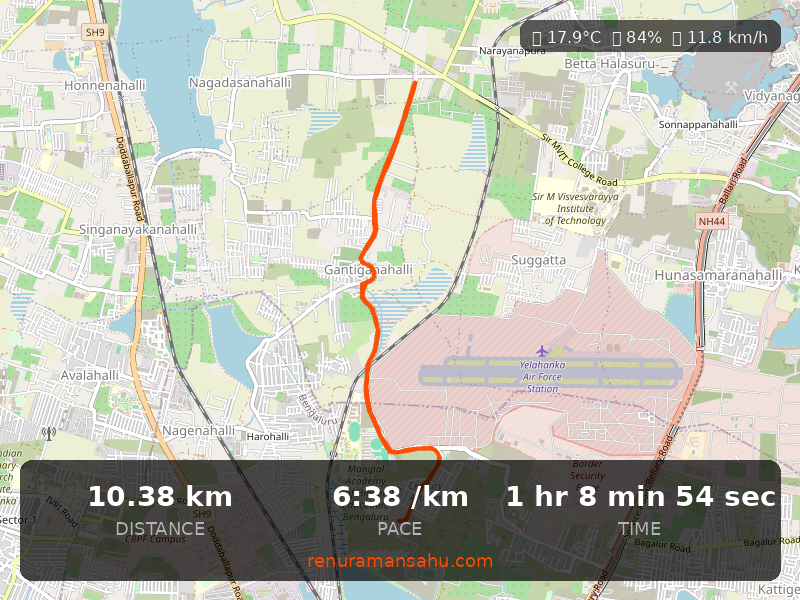
Run Snapshot
Raman covered 10.38 km at a 6:38 min:sec/km average pace, completing the run in 68.9 minutes. The run took place at 06:31:10Z on January 25, 2026, with a temperature of 17.9°C and humidity of 84%. No heart rate data is available for this session.
Pace & Effort Breakdown
The gap between Raman’s average pace of 6:38 min:sec/km and max pace of 2:55 min:sec/km reveals a pacing strategy that includes significant variation, potentially indicating interval training or a strong finish. Since heart rate data is not available, effort-to-pace ratio cannot be calculated. However, Raman’s average cadence of 80.2 spm is below the optimal range of 170-185 spm, suggesting room for improvement in form efficiency. Given the temperature of 17.9°C, no significant pace slowdown due to heat is expected. The dew point of 15.2°C is relatively high, which may impact evaporative cooling and breathing, but its effect is not quantifiable without further data.
Route Narrative
The run began with a moderate 7:42 min:sec/km pace in the first kilometer, followed by a significant drop to 5:50 min:sec/km in the second kilometer, where elevation decreased by 6.0 meters. The pace then stabilized around 6:15-6:33 min:sec/km for the next few kilometers, with some variation in response to elevation changes. The fastest segment was the 11th kilometer, completed at a 4:34 min:sec/km pace, likely due to a finishing sprint. The slowest segment was the 9th kilometer, with an 8:01 min:sec/km pace, potentially resulting from fatigue or a strategic decision to conserve energy. The run exhibited negative splits, with the first half completed at an average pace of 6:51 min:sec/km and the second half at 6:25 min:sec/km, indicating a strong finish.
Elevation Profile
Pace Analysis
Workload Intelligence
Raman's ACWR value is 2.06, which falls into the danger zone, indicating a high injury risk. The acute load of 80.0 over the past 7 days exceeds the chronic load of 38.9, suggesting a significant increase in training intensity. At an ACWR of 2.06, the acute load of 80.0 sits above the chronic baseline of 38.9, indicating a potential overreaching situation. With 3 runs in the past 7 days and a total distance of 14.4 km, the weekly run count and distance trends are relatively low, but the high ACWR value still poses a concern.
Physiological Impact
Based on the average pace of 6:38 min:sec/km and duration of 68.9 minutes, this session likely targeted the aerobic energy system. The lack of heart rate data limits the analysis, but the pace and duration suggest improvements in mitochondrial density, capillarization, and lactate clearance. The session's energy expenditure of 756.0 kcal also indicates an increase in fat oxidation. However, without heart rate data, the exact physiological impact remains uncertain.
Recovery & Next Session
Given the high ACWR value and significant acute load, Raman should prioritize recovery, aiming for at least 48 hours of rest or low-intensity training before the next high-intensity session. The next workout should be a low-intensity, 5-7 km easy run at a pace range of 7:30-8:00 min:sec/km, allowing for active recovery and a gradual return to high-intensity training. This prescription is based on the current load data and aims to mitigate the risk of injury associated with the high ACWR value.
Training Trajectory
Over the past 28 days, Raman's total distance was 27.9 km, with an average weekly distance of approximately 10 km. This trend appears relatively stable, but the recent increase in acute load poses a concern. To progress safely, Raman should aim to reduce the ACWR value to within the optimal range of 0.8-1.3. A concrete coaching directive would be to target an ACWR of 1.2 over the next two weeks, with a weekly distance goal of 15-20 km and a target pace range of 6:20-6:50 min:sec/km for high-intensity sessions.
View the original activity on Strava