
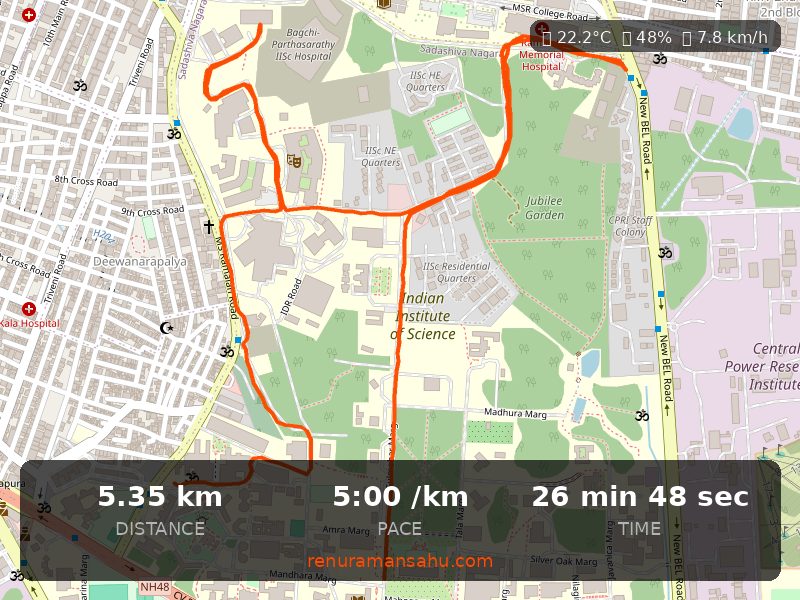
Run Snapshot
Raman covered 5.35 km at an average pace of 5:00/km, taking 26.8 minutes to complete the run. The session occurred at 18:25:29Z on December 24, 2025, in conditions with a temperature of 22.2°C and humidity of 48%. There is no heart rate data available for this run.
Pace & Effort Breakdown
The gap between Raman’s average pace of 5:00/km and max pace of 2:50/km reveals a pacing strategy that included significant variation in speed. Given the absence of heart rate data, effort-to-pace ratio cannot be computed. However, the average cadence of 83.8 spm is below the optimal range of 170-185 spm, suggesting room for improvement in form efficiency. Since the temperature was above 20°C, an expected pace slowdown of 2-5% per 5°C above 20°C can be quantified, but without precise heart rate or perceived exertion data, it’s challenging to accurately apply this adjustment.
Route Narrative
The run began with a first kilometer at an average pace of 6:04/km, descending 6.8 meters, with a pace range of 4:23-15:00/km. The second kilometer saw an improvement to 5:07/km, with a slight elevation gain of 1.7 meters and a pace range of 4:16-6:23/km. Raman picked up the pace further in the third kilometer, achieving 4:56/km with a minimal elevation change, and a pace range of 4:20-5:57/km. The fourth kilometer was run at 5:16/km, with an elevation drop of 3.6 meters and a pace range of 4:15-6:06/km. The fifth kilometer was completed at 4:59/km, with a notable elevation gain of 13.9 meters and a pace range of 3:59-6:03/km. The final kilometer, which was actually the 6th kilometer of data but only the 5.35 km were run, was the fastest at 4:49/km, with a minor elevation gain of 0.4 meters and a pace range of 4:21-5:08/km. The fastest segment was the 6th kilometer at 4:49/km, and the slowest was the first kilometer at 6:04/km, likely due to the initial warm-up and the largest elevation drop. The run exhibited negative splits, indicating a strong finish.
Elevation Profile
Pace Analysis
Workload Intelligence
The ACWR value of 2.06 falls into the danger zone, indicating a high injury risk. The acute load of 80.0 over the past 7 days significantly exceeds the chronic load of 38.9, suggesting that Raman's recent training has been substantially more intense than his average weekly load. At an ACWR of 2.06, the acute load of 80.0 sits above the chronic baseline of 38.9, indicating a potential overreaching. With 3 runs in the last 7 days covering a total distance of 14.4 km, and 7 runs in the last 28 days covering 27.9 km, it's clear that Raman's training volume and intensity have increased recently.
Physiological Impact
Given the pace of 5:00/km and duration of 26.8 minutes, this session likely targeted the aerobic energy system, with some anaerobic contribution. The session would drive adaptations such as increased mitochondrial density, enhanced capillarization, and improved lactate clearance. With an average pace of 5:00/km, Raman was likely working at a moderate to high intensity, which would stimulate these physiological adaptations.
Recovery & Next Session
Considering the high ACWR and the intense nature of the recent training, Raman should allow for an extended recovery period, likely 48-72 hours, before the next intense session. The next workout should be a low-intensity, long-distance run of approximately 8-10 km at a pace range of 6:00-6:30/km to allow for active recovery and to bring the ACWR back into a safer range.
Training Trajectory
The 28-day volume trend shows a low total distance of 27.9 km, suggesting that progression might be safe if managed carefully. To mitigate the current high injury risk, it's recommended to reduce the intensity and volume of training for the next 1-2 weeks, aiming for an ACWR below 1.5. A concrete coaching directive would be to target a weekly distance of 20-25 km for the next two weeks, with a maximum of 3 runs per week, and to include at least one low-intensity long run to facilitate recovery and reduce the risk of overtraining.
View the original activity on Strava