
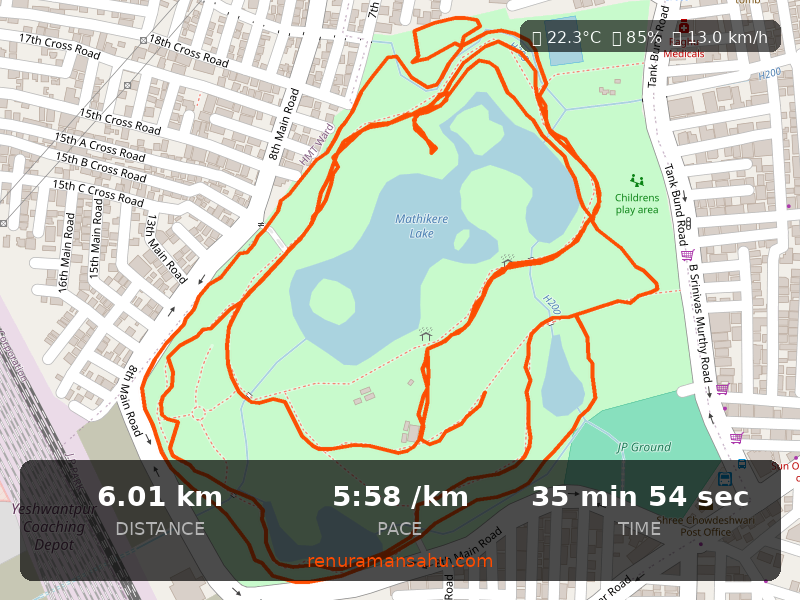
Run Snapshot
Raman completed a 6.01K easy run at an average pace of 5:58/km in the morning, with a temperature of 22.3°C and humidity of 85%. The run lasted 35.9 minutes, with an elevation gain of 20.6 meters. Unfortunately, heart rate data was not available for this session.

Pace & Effort Breakdown
The average pace of 5:58/km and max pace of 2:31/km indicate a significant gap, suggesting Raman may have started with a conservative pacing strategy. Given the temperature was above 20°C, a pace slowdown of around 2-5% can be expected. The dew point of 19.7°C may have had a minor impact on evaporative cooling and breathing. With an AQI of 37 (estimated from atmospheric model), the air quality had a negligible effect on Raman’s performance.
Route Narrative
The run can be broken down into six segments, with varying paces and elevation changes. The first kilometer was completed at an average pace of 6:58/km, with a slight elevation gain. The pace picked up in the subsequent kilometers, with the fourth kilometer being the fastest at 6:01/km. The cadence ranged from 155 to 163 spm, indicating a relatively consistent form. The route featured a mix of uphill and downhill segments, with the pace responding accordingly. The fastest segment was the fourth kilometer, which may be attributed to the slight elevation gain and Raman’s increasing cadence.
Run Analysis
Workload Intelligence
The ACWR value of 2.06 indicates that Raman is in the danger zone, with a high injury risk. The acute load of 95.2 is significantly higher than the chronic load of 46.2, suggesting that Raman may be overreaching. With a weekly run count of 3 and a total distance of 17.1 km in the past 7 days, Raman's training load is relatively high. At an ACWR of 2.06, the acute load of 95.2 sits above the chronic baseline of 46.2, indicating a need to reduce the training intensity.

Physiological Impact
Based on the pace and duration of the run, it is likely that Raman's aerobic system was targeted. The session may have driven adaptations such as increased mitochondrial density and capillarization. However, the relatively high intensity of the run may have also resulted in some anaerobic energy expenditure. With an AQI of 37, there is no significant added respiratory stress.
Recovery & Next Session
Given the high ACWR value and acute load, it is recommended that Raman takes an extended recovery period of at least 48 hours before the next hard session. The next workout should be a low-intensity 5K easy run at a pace of around 6:30/km. This will allow Raman to recover and rebuild while maintaining some aerobic stimulus.
Training Trajectory
The 28-day volume trend indicates that Raman's progression may not be entirely safe, given the high ACWR value. It is recommended that Raman reduces the training intensity and focuses on active recovery for the next week. The goal for the next 2 weeks should be to reduce the ACWR to a safer range of 1.3 or lower, with a weekly km goal of around 20-25 km. A concrete coaching directive would be to aim for a 10K easy run at a pace of 6:15/km in the next 10 days, while closely monitoring the ACWR value.
View the original activity on Strava
Gear Used: Asics Novoblast 5 (Shoes)
Transparency: The links above are affiliate links — if you purchase through them, I earn a small commission at no extra cost to you. It helps support my training and this data analysis hobby project.