
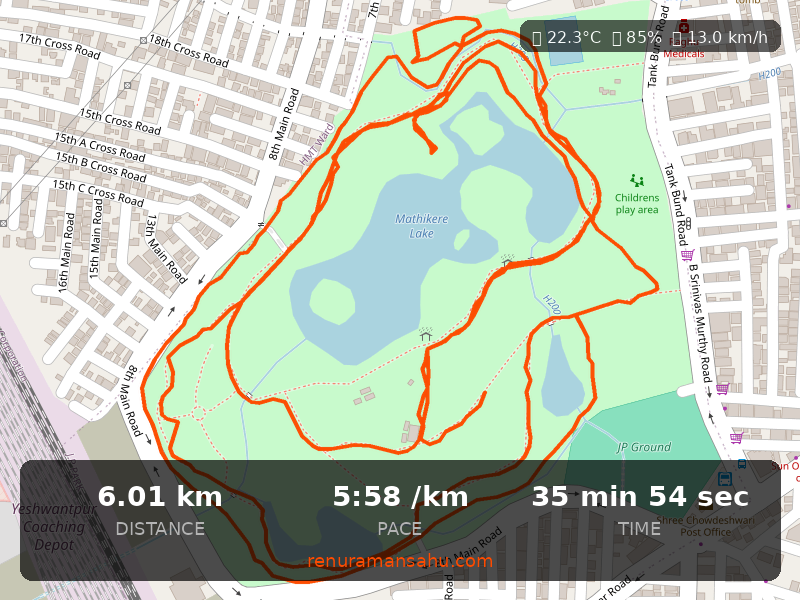
Run Snapshot
Raman completed a 6.01 km easy run at an average pace of 5:58/km in the morning, with an elapsed time of 36 minutes, under a temperature of 22.3°C, humidity of 85%, and an Air Quality Index (AQI) of 37, which is considered good. The run took place at 07:39 AM IST, indicating a morning session. Unfortunately, heart rate data is not available for this session.

Pace & Effort Breakdown
The average pace of 5:58/km and max pace of 2:31/km suggest a significant pace variation throughout the run, possibly indicating a mix of easy and faster segments. Since heart rate data is not available, we cannot compute an effort-to-pace ratio. However, the average cadence of 79.1 spm is below the optimal range of 170-185 spm, suggesting potential for improvement in form efficiency. Given the temperature was above 20°C, a slight pace slowdown would be expected, but the impact is minimal at this level of exertion.
Route Narrative
The run can be broken down into six segments, each with its unique characteristics. The first kilometer was completed at an average pace of 6:58/km, with an elevation gain of 0.3 meters. The pace quickened to 6:24/km in the second kilometer, accompanied by a slight elevation loss. The fastest segment was the fourth kilometer, completed at 6:01/km, which might indicate a segment with favorable terrain or a moment of increased effort. The cadence varied across segments, with the highest being 163 spm in the fourth kilometer, suggesting better form efficiency in that part of the run.
Run Analysis
Workload Intelligence
Raman's Acute to Chronic Workload Ratio (ACWR) stands at 2.06, indicating a danger zone with a high injury risk. The acute load of 95.2 over the last 7 days significantly exceeds the chronic load baseline of 46.2, suggesting a recent spike in training intensity or volume. With 3 runs in the last 7 days covering a total distance of 17.1 km, and 6 runs in the last 28 days covering 33.2 km, it's clear that the training load has increased substantially in the short term.

Physiological Impact
Given the pace and duration of the run, it's likely that the aerobic system was the primary energy system targeted. This session would contribute to improvements in mitochondrial density, capillarization, and potentially lactate clearance, given the easy to moderate intensity. However, without heart rate data, it's challenging to precisely determine the physiological strain. The good air quality, as indicated by an AQI of 37, meant that there was negligible impact on performance from air quality.
Recovery & Next Session
Considering the high ACWR and the danger zone classification, it's essential for Raman to allow for adequate recovery time before the next intense session. A recovery period of at least 48 hours is recommended before engaging in another high-intensity workout. The next session should be a low-intensity 3-4 km easy run, aiming for a pace range of 6:30-7:00/km, to help in reducing the ACWR and mitigating the risk of injury.
Training Trajectory
The 28-day volume trend indicates a progression that may not be entirely safe, given the recent spike in training load. To adjust the trajectory, it's recommended to reduce the weekly volume by 10-15% for the next two weeks and aim for an ACWR below 1.5 to move out of the danger zone. A concrete coaching directive would be to limit the weekly running distance to 20-25 km for the next fortnight, focusing on gradual progression and injury prevention.
Takeaway
Monitor and adjust training load to prevent injury.
View the original activity on Strava
Gear Used: Asics Novoblast 5 (Shoes)
Transparency: The links above are affiliate links — if you purchase through them, I earn a small commission at no extra cost to you. It helps support my training and this data analysis hobby project.