
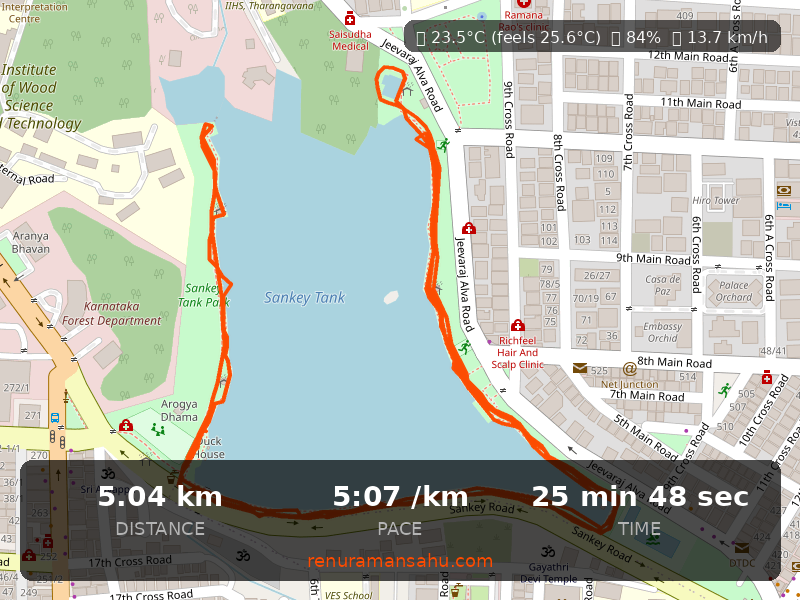
Run Snapshot
Raman completed a 5.04K easy run at an average pace of 5:07/km, taking 25.8 minutes to finish. The evening run, which started at 06:52 PM IST, was conducted in warm conditions with a temperature of 23.5°C and humidity of 84%. The Air Quality Index (AQI) was moderate at 56.

In Raman’s Own Words
Raman noted that “it wasn’t me running, ’twas the runner’s high that dragged me after the first km.” This suggests that he experienced a challenging start but found his rhythm as the run progressed. His average cadence of 79.4 spm indicates a consistent stride, which may have contributed to his ability to settle into a pace after the initial kilometer.
Pace & Effort Breakdown
Comparing Raman’s average pace of 5:07/km to his maximum pace of 2:14/km reveals a significant gap, indicating that he may have been holding back and pacing himself for the duration of the run. Although heart rate data is not available, his cadence of 79.4 spm is below the optimal range of 170-185 spm, suggesting room for improvement in terms of form efficiency. Given the temperature of 23.5°C, a pace slowdown of around 2-5% can be expected, which may have contributed to his average pace.
Route Narrative
The run can be broken down into five segments, each with its unique characteristics. The first kilometer, completed at an average pace of 6:02/km, was the slowest, with an elevation gain of 0.2m. The pace quickened in the subsequent kilometers, with the fifth kilometer being the fastest at 4:56/km. Raman’s cadence remained relatively consistent, ranging from 156 to 162 spm, with a slight increase in the later stages of the run. The negative split, with the second half of the run being faster than the first, indicates a well-executed pacing strategy.
Run Analysis
Workload Intelligence
Raman's Acute-to-Chronic Workload Ratio (ACWR) is 1.63, which falls into the danger zone, indicating a high injury risk. His acute load of 61.8 is significantly higher than his chronic load of 37.8, suggesting that he may be overreaching. With only two runs in the past seven days and a total distance of 11.1 km, Raman's training load is relatively low, but the high ACWR value warrants caution.

Physiological Impact
Given the pace and duration of the run, it is likely that Raman's aerobic system was the primary energy source. This session would have driven adaptations such as increased mitochondrial density and capillarization. However, the moderate AQI of 56 may have introduced some respiratory stress, and Raman should be mindful of this when planning his next session.
Recovery & Next Session
Considering the high ACWR value and the moderate intensity of the run, Raman should prioritize recovery and aim for at least 48 hours of rest or low-intensity activity before his next session. A suitable next workout could be a 3K easy run at a pace of 5:30-6:00/km, focusing on active recovery and allowing his body to adapt to the recent training load.
Training Trajectory
Raman's 28-day volume trend is relatively low, with a total distance of 27.2 km. To progress safely, he should aim to increase his weekly mileage by no more than 10% and focus on building his aerobic base. A concrete coaching directive would be to target an ACWR of 1.2 or lower over the next two weeks, with a weekly distance goal of 20-25 km and a pace target of 5:00-5:30/km for his next few sessions.
View the original activity on Strava
Gear Used: Asics Novoblast 5 (Shoes)
Transparency: The links above are affiliate links — if you purchase through them, I earn a small commission at no extra cost to you. It helps support my training and this data analysis hobby project.