
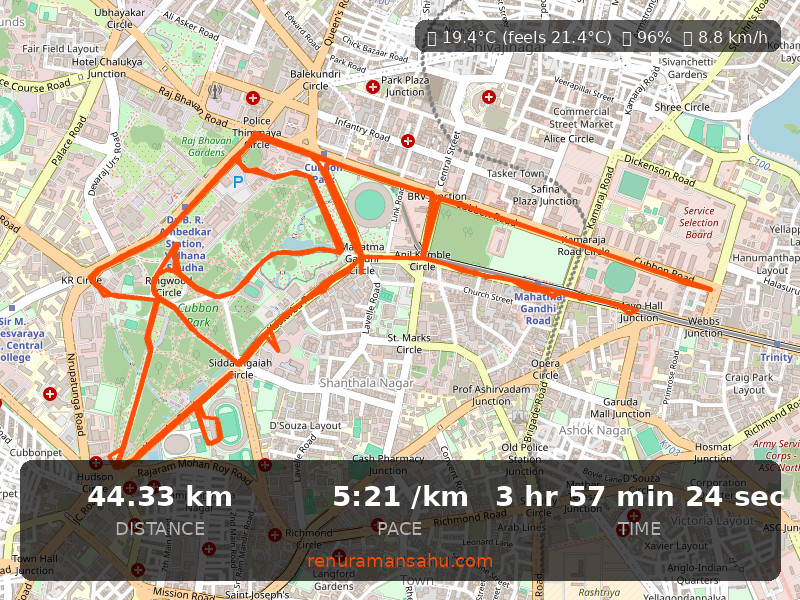
Run Snapshot
Raman completed a 44.33 km run in 237.4 minutes, achieving an average pace of 5:21 min/km. The run took place at a temperature of 19.4°C, with a feels-like temperature of 21.4°C and humidity at 96%. The conditions were warm and humid, which can slow pace by 2-5% per 5°C above 20°C.
Pace & Effort Breakdown
Raman’s average pace was 5:21 min/km, while the maximum pace reached was 0:54 min/km, indicating a significant gap between the fastest and average pace. This suggests that the pacing strategy may have been conservative, with occasional bursts of speed. The average cadence of 83.2 steps per minute (spm) is below the optimal range of 170-185 spm, indicating room for improvement in running form efficiency. Given the high humidity and temperature, the pace was likely affected, with the dew point of 18.8°C potentially impacting breathing and evaporative cooling.
Route Narrative
The run can be divided into several segments, each with its unique characteristics. The first 5 km saw Raman settle into a rhythm, with an average pace of 6:15 min/km in the second kilometer. The pace then dropped to 4:38 min/km in the fourth kilometer, indicating a strong start. The middle section of the run, between kilometers 10-20, saw Raman maintain a consistent pace, with an average of 5:07 min/km in the 19th kilometer. However, the pace began to slow down in the later stages, with an average of 6:00 min/km in the 28th kilometer. The fastest segment was the 5th kilometer, with an average pace of 4:07 min/km, while the slowest was the 42nd kilometer, with an average pace of 10:45 min/km. This suggests that Raman may have started to fatigue towards the end of the run.
Workload Intelligence
Raman’s Acute:Chronic Workload Ratio (ACWR) is 2.06, indicating a high injury risk. The acute load of 80.0 sits above the chronic baseline of 38.9, suggesting that Raman may be overreaching. With only 3 runs in the past 7 days and 7 runs in the past 28 days, the training frequency is relatively low. To mitigate the risk of injury, it is essential to monitor the ACWR and adjust the training load accordingly. An ACWR between 0.8-1.3 is considered optimal, while a ratio above 1.5 indicates a high risk of injury.
Physiological Impact
Given the pace, duration, and effort, this session primarily targeted the aerobic energy system. The average pace of 5:21 min/km suggests that Raman was working at a moderate to high intensity, with a significant portion of the energy expenditure coming from aerobic metabolism. This session is likely driving adaptations such as increased mitochondrial density, capillarization, and lactate clearance. The lack of heart rate data limits the analysis, but the pace and duration suggest a significant cardiovascular and muscular load.
Recovery & Next Session
Given the high ACWR and the effort expended during this session, Raman should prioritize recovery before the next session. A minimum of 48-72 hours of rest or active recovery is recommended. The next session should be a low-intensity, short-duration run, with a target pace of 6:30-7:00 min/km. This will allow Raman to recover while maintaining some level of cardiovascular and muscular stimulation. The reasoning behind this prescription is to reduce the ACWR and mitigate the risk of injury, while still allowing for some level of training adaptation.
Training Trajectory
Zooming out to the 28-day picture, Raman’s training volume has been relatively low, with only 27.9 km run in the past 28 days. The progression rate has been slow, but the recent increase in training load may be too aggressive, given the high ACWR. To optimize adaptation without spiking injury risk, Raman should aim to increase the training volume by no more than 10% per week. The next 1-2 weeks should focus on building aerobic endurance, with a target weekly volume of 30-40 km. The ACWR should be monitored closely, with a target ratio of 0.8-1.3.
To achieve this, Raman should aim to maintain an ACWR of 1.2 or below, with a weekly volume of 35 km. The next session should be a 10 km easy run, with a target pace of 6:45 min/km. By following this plan, Raman can reduce the risk of injury while continuing to adapt to the demands of endurance running.
View the original activity on Strava
Elevation Profile