
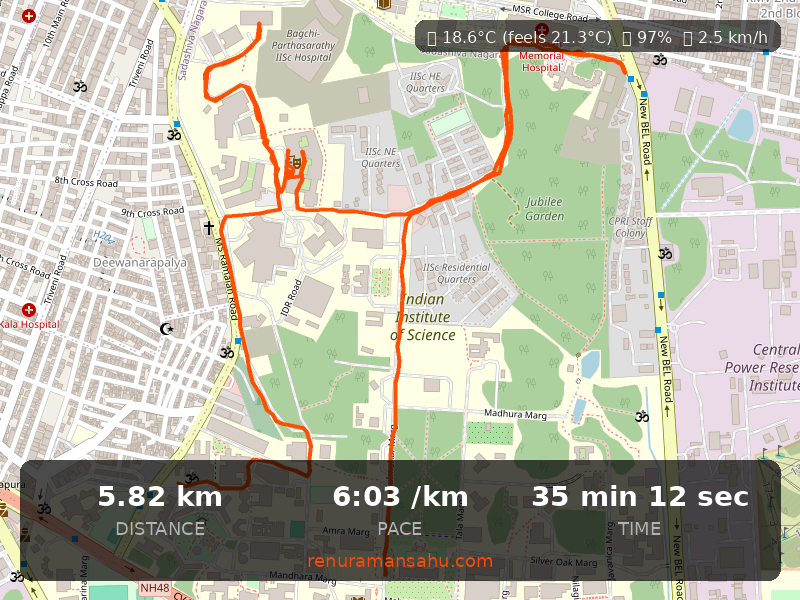
Run Snapshot
Raman’s New Year’s Day run, titled “Jay Shree Ram,” covered a distance of 5.82 km in a moving time of 35.2 minutes, resulting in an average pace of 6:03 min/km. The run took place at 06:20:06Z, with the temperature at 18.6°C, feeling like 21.3°C due to 97% humidity. The elevation gain was 39.4 meters.
Pace & Effort Breakdown
The average pace of 6:03 min/km and max pace of 1:59 min/km indicate a significant pace variation throughout the run. The cadence of 81.5 steps per minute (spm) is slightly below the optimal range of 170-185 spm, suggesting room for improvement in running form efficiency. Considering the high humidity and temperature, the pace may have been slowed by approximately 2-5% due to the heat. The dew point of 18.1°C may have also impacted breathing and evaporative cooling.
Route Narrative
Raman’s run can be broken down into six segments, each with distinct pace and elevation characteristics. The first kilometer, with an average pace of 6:29 min/km, started with a slight downhill, losing 6.7 meters of elevation. The pace picked up slightly in the second kilometer, with an average pace of 6:25 min/km, as the elevation increased by 1.6 meters. The third kilometer was the slowest, with an average pace of 7:52 min/km, and included an elevation gain of 4.6 meters. Raman regained speed in the fourth kilometer, achieving an average pace of 6:11 min/km, as the elevation decreased by 13.2 meters. The fifth kilometer had an average pace of 6:27 min/km, with an elevation gain of 13.2 meters. The final kilometer was the fastest, with an average pace of 5:45 min/km, and included an elevation gain of 4.9 meters.
Workload Intelligence
Raman’s Acute Chronic Workload Ratio (ACWR) is 2.06, indicating a high injury risk due to overreaching. The acute load of 80.0 and chronic load of 38.9 suggest that the recent training has been significantly more intense than the average over the past 28 days. This high ACWR puts Raman in the “danger zone,” requiring careful management of training loads to avoid injury. With three runs in the past seven days and a total distance of 14.4 km, the training frequency and volume need to be monitored closely.
Physiological Impact
Given the average pace of 6:03 min/km and the lack of heart rate data, it is challenging to determine the exact energy system targeted during this run. However, the moderate intensity and duration suggest that the session likely engaged the aerobic system, driving adaptations such as increased mitochondrial density, capillarization, and fat oxidation. The high intensity of the final kilometer may have also recruited the anaerobic system, contributing to improvements in lactate clearance and muscle buffering capacity.
Recovery & Next Session
Considering the high ACWR and the intense effort of the recent run, Raman should prioritize recovery before the next session. A low-intensity, short-duration run of approximately 3-4 km at a pace of 7:00-7:30 min/km would be a suitable next workout, allowing for active recovery while minimizing the risk of further overload. The focus should be on maintaining a consistent chronic load while gradually reducing the acute load to achieve a more balanced ACWR.
Training Trajectory
Over the next 1-2 weeks, Raman should aim to decrease the ACWR by reducing the acute load while maintaining or slightly increasing the chronic load. This can be achieved by incorporating more low-intensity runs and gradual progression of training volume. A weekly target of 20-25 km, with 3-4 runs per week, would be a reasonable and sustainable progression, allowing for continued adaptation without excessive injury risk. The target ACWR should be within the optimal range of 0.8-1.3, indicating a balanced and safe training load.
To achieve this, Raman should aim for an ACWR of 1.2, a weekly distance of 22 km, and a next session pace of 7:15 min/km. By carefully managing the training load and prioritizing recovery, Raman can minimize the risk of injury and optimize adaptation.
View the original activity on Strava
Elevation Profile