
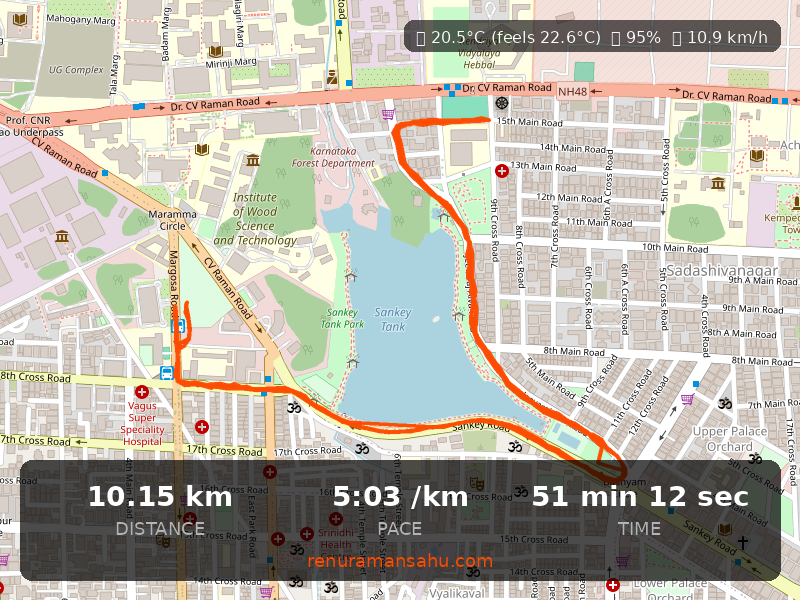
Run Snapshot
Raman completed a 10K tempo run at an average pace of 5:03/km, covering a distance of 10.15 km in 51.2 minutes on a morning with a temperature of 20.5°C, humidity of 95%, and an Air Quality Index (AQI) of 41, indicating good air quality. The run took place at 06:31 AM IST, with a stopped time of 1 minute. Raman’s average cadence was 81.7 spm, and the elevation gain was 35.7 meters.

Pace & Effort Breakdown
The gap between Raman’s average pace of 5:03/km and max pace of 1:29/km reveals a pacing strategy that allowed for a strong finish. Although heart rate data is not available, the average cadence of 81.7 spm suggests a relatively efficient form. Given the temperature of 20.5°C, the expected pace slowdown is minimal. The dew point of 19.7°C may have had a slight impact on evaporative cooling and breathing, but it is not significant. The AQI of 41, estimated from atmospheric models, indicates a negligible effect on performance.
Route Narrative
The run can be narrated km-by-km, with Raman starting at a pace of 6:29/km in the first kilometer, followed by a faster pace of 4:59/km in the second kilometer. The pace responded to elevation changes, with Raman slowing down to 6:55/km in the seventh kilometer, which had a slight elevation drop. Cadence data shows that Raman’s cadence shifted throughout the run, with a high of 168 spm in the tenth kilometer. The fastest segment was the tenth kilometer, with a pace of 4:46/km, indicating a strong finish.
Run Analysis
Workload Intelligence
The ACWR value of 2.17 indicates that Raman is in the danger zone, with a high injury risk. The acute load of 145.6 is significantly higher than the chronic load of 67.2, suggesting that Raman may be overreaching. With a weekly run count of 4 and a total distance of 26.2 km in the past 7 days, Raman's training load is high. At an ACWR of 2.17, the acute load of 145.6 sits above the chronic baseline of 67.2, indicating a need to reduce the training load to avoid injury.

Physiological Impact
Based on the pace and duration of the run, it appears that Raman targeted his aerobic system. The run likely drove adaptations such as increased mitochondrial density, capillarization, and lactate clearance. Although the AQI was relatively low, the high intensity of the run may have still caused some respiratory stress. The lack of heart rate data makes it difficult to determine the exact physiological impact, but the pace and cadence data suggest a challenging workout.
Recovery & Next Session
Given the high ACWR value and the intense nature of the run, it is recommended that Raman takes a recovery period of at least 48 hours before the next hard workout. The next workout should be a low-intensity easy run of 5-7 km at a pace of 6:00-7:00/km, allowing Raman's body to recover and adapt to the previous workout. This will help reduce the risk of injury and allow Raman to continue training effectively.
Training Trajectory
The 28-day volume trend shows that Raman has been increasing his training load, but the high ACWR value suggests that this progression may not be safe. It is recommended that Raman reduces his training load over the next 1-2 weeks to avoid injury. A concrete coaching directive would be to aim for an ACWR value of 1.5 or lower, with a weekly km goal of 20-25 km and a pace target of 5:30-6:00/km for easy runs.
View the original activity on Strava
Gear Used: Asics Novoblast 5 (Shoes)
Transparency: The links above are affiliate links — if you purchase through them, I earn a small commission at no extra cost to you. It helps support my training and this data analysis hobby project.