
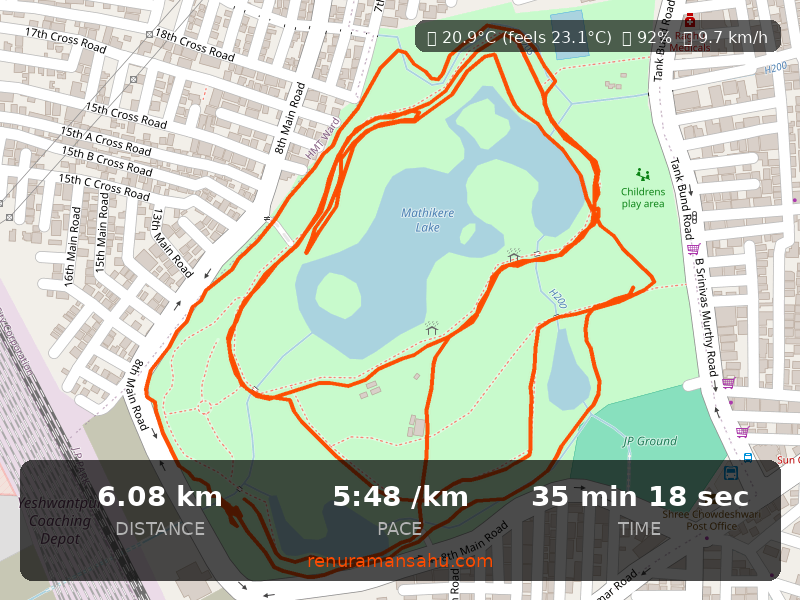
Run Snapshot
Raman completed a 6.08K easy run at an average pace of 5:48/min/km in the morning, with a moving time of 35.3 minutes. The run took place at 06:58 AM IST on June 19, 2026, with a temperature of 20.9°C, humidity of 92%, and an Air Quality Index (AQI) of 55, which is considered moderate. The weather conditions were relatively calm, with a wind speed of 9.7 km/h and no precipitation.

Pace & Effort Breakdown
The average pace of 5:48/min/km and max pace of 3:41/min/km indicate a significant gap, revealing a potential pacing strategy that involved starting conservatively and increasing the pace throughout the run. Although heart rate data is not available, the average cadence of 79.9 spm suggests that Raman maintained a consistent and efficient form throughout the run. Given the temperature of 20.9°C, a slight pace slowdown can be expected, but the impact is minimal. The dew point of 19.5°C is relatively high, which may have affected evaporative cooling and breathing. The AQI of 55, estimated from atmospheric models, is expected to have a negligible effect on performance.
Route Narrative
The run can be broken down into six segments, each with its unique characteristics. The first kilometer was completed at an average pace of 8:49/min/km, with an elevation loss of 4.4 meters. The pace increased significantly in the second kilometer, with an average pace of 6:07/min/km and an elevation gain of 1.2 meters. The fastest segment was the sixth kilometer, completed at an average pace of 5:38/min/km, with an elevation gain of 0.4 meters. The cadence varied throughout the run, with the highest cadence of 162 spm recorded in the sixth kilometer. The run exhibited a negative split, with the second half completed faster than the first half.
Run Analysis
Workload Intelligence
The Acute Chronic Workload Ratio (ACWR) is 0.88, which falls within the optimal training zone. The acute load of 33.8 is below the chronic load of 38.5, indicating a relatively low training load. With a weekly run count of 1 and a total distance of 6.1 km in the past 7 days, Raman's training load is manageable. At an ACWR of 0.88, the acute load of 33.8 sits below the chronic baseline of 38.5, suggesting a safe and sustainable training load.

Physiological Impact
Based on the pace and duration of the run, it appears that the aerobic energy system was targeted. This session is likely to drive adaptations such as increased mitochondrial density, capillarization, and lactate clearance. Although the AQI was moderate, the PM2.5 level of 11.3 µg/m³ is relatively low, and the risk of airway inflammation is minimal. The run's physiological impact is expected to be positive, with improvements in cardiovascular fitness and muscular endurance.
Recovery & Next Session
Given the relatively low training load, Raman can expect a quick recovery. A recovery duration of 24-48 hours is recommended before the next workout. The next session should be a threshold workout with a distance of 8-10 km and a target pace range of 5:20-5:40/min/km. This workout will help Raman build on the aerobic base established in this session and improve his lactate threshold.
Training Trajectory
The 28-day volume trend indicates a safe progression, with a total distance of 27.7 km in the past 28 days. To continue progressing safely, Raman should aim to increase his weekly distance by 10-15% over the next two weeks. A concrete coaching directive is to target an ACWR of 0.9-1.0 and a weekly distance of 30-35 km in the next two weeks, with a focus on building aerobic endurance and improving running efficiency.
View the original activity on Strava
Gear Used: Asics Novoblast 5 (Shoes)
Transparency: The links above are affiliate links — if you purchase through them, I earn a small commission at no extra cost to you. It helps support my training and this data analysis hobby project.