
Unpacking Raman’s Latest Run: A Data-Driven Analysis
At renuramansahu.com, we believe in stripping away the fluff and diving deep into the numbers that truly tell an athlete’s story. Today, we’re dissecting Raman’s recent activity to understand not just the immediate effort, but its implications for his broader training trajectory. As an endurance running coach and exercise physiologist, the data provides a clear roadmap.
Run Snapshot
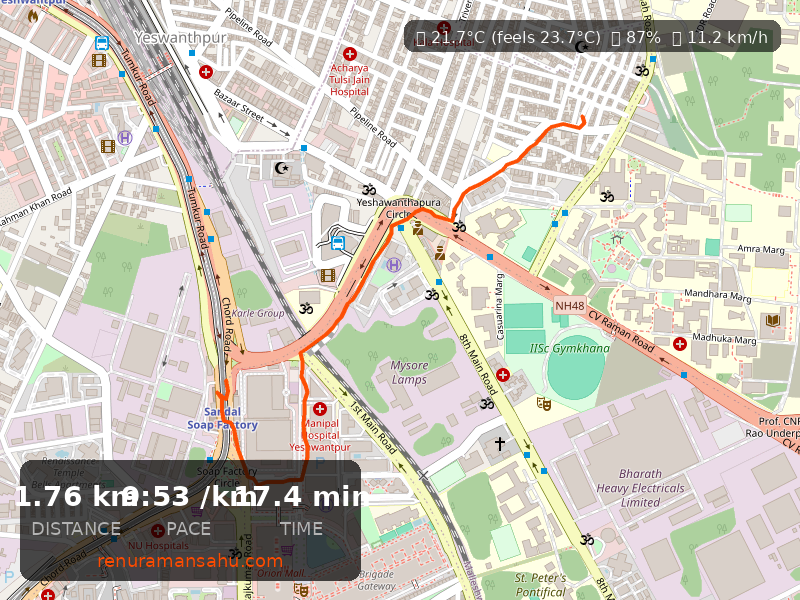
Raman embarked on a short 1.76 km run on May 20, 2026, at 06:50 AM, logging a moving time of 17.4 minutes. His average pace for this session was 9:53 per kilometer, with minimal elevation gain of just 6.6 meters. The environmental conditions were challenging: a temperature of 21.7°C, feeling like 23.7°C, coupled with high humidity at 87% and a dew point of 19.5°C.
Pace & Effort Breakdown
Raman’s average pace of 9:53/km contrasted sharply with a maximum pace of 4:08/km. This significant variance suggests the session was not a continuous, steady-state run, but rather involved periods of walking or very slow jogging interspersed with brief, quicker bursts. This aligns with the activity description of “a small run to test” new coaching software, indicating a technical rather than a performance-focused effort.
The absence of heart rate data prevents a direct assessment of physiological effort relative to pace. However, Raman’s average cadence of 62.6 steps per minute is notably low for running, often indicative of walking or a shuffle rather than an efficient running stride (optimal cadence for most runners falls between 170-185 spm). This further supports the interpretation of a mixed-modality session.
Environmental factors played a role in the perceived effort. With the temperature at 21.7°C and feeling like 23.7°C, performance can be expected to be impacted. Furthermore, the high humidity (87%) and a dew point of 19.5°C (well above the 16°C threshold) would have significantly hindered evaporative cooling, making breathing feel heavier and increasing the perceived exertion for any given pace. Even a low-intensity effort in these conditions would tax the thermoregulatory system.
Workload Intelligence
The most critical insight from Raman’s data lies in his training load metrics. His Acute:Chronic Workload Ratio (ACWR) stands at 2.06. This ratio is derived from an acute load (last 7 days) of 80.0, compared to a chronic load (weekly average over 28 days) of 38.9. In practical terms, Raman’s training volume and intensity in the past week have more than doubled his average weekly load over the preceding month.
Referring to established ACWR zones:
- Below 0.8: Undertraining / detraining risk
- 0.8–1.3: Optimal training zone
- 1.3–1.5: Overreaching — caution
- Above 1.5: Danger zone — high injury risk
At an ACWR of 2.06, Raman is firmly in the “Danger Zone,” indicating a high risk of injury. This is corroborated by the system’s assessment of “Health Status: Danger Zone” and “Injury Risk: High.” The data shows Raman completed 3 runs in the last 7 days, covering 14.4 km, which accounts for almost half of his total 28-day distance of 27.9 km (7 runs). This rapid spike in recent activity, regardless of the individual session’s intensity, is the primary driver of the elevated injury risk.
Physiological Impact
Given the short distance (1.76 km), low average pace (9:53/km), and extremely low cadence, this particular session likely provided a minimal physiological stimulus. It was primarily an aerobic effort, operating at a very low intensity. For a trained individual, such a session would barely register in terms of driving significant adaptations like increased mitochondrial density, capillarization, or lactate clearance capacity. It functions more as active recovery or a movement break than a structured training stimulus. The primary “impact” would be on Raman’s overall acute load, contributing to the concerning ACWR, rather than specific physiological gains from this single run.
Recovery & Next Session
Considering Raman’s current ACWR of 2.06 and the associated high injury risk, the immediate priority is to reduce the acute load and allow the chronic load to build without further spikes. This means prioritizing recovery and very light activity for the next few days.
Raman needs to strategically reduce his acute load to bring his ACWR back into the optimal 0.8–1.3 range. This will require deliberately scaling back the total training load for the next 7-10 days.
Prescribed Next Workout:
- Type: Very Easy Aerobic Run / Active Recovery
- Distance: 2.5 – 3.0 km
- Target Pace: Extremely conversational, focusing on comfortable movement, likely in the 7:30-8:30/km range.
- Intensity: Zone 1-2, RPE 2-3 out of 10.
- Reasoning: To provide a gentle stimulus without increasing the acute load or exacerbating injury risk, allowing the body to adapt to the recent spike in volume and reduce systemic stress.
Training Trajectory
Zooming out to the 28-day window, Raman’s training shows a low baseline volume (27.9 km over 7 runs). The recent increase to 14.4 km in the last 7 days, while not high in absolute terms, represents a significant percentage increase relative to his chronic baseline, leading to the dangerous ACWR of 2.06. This progression rate is currently unsustainable and carries a high injury risk.
To optimize adaptation without spiking injury risk, the next 1-2 weeks must focus on stabilization and gradual load management. Raman should aim to keep his weekly running distance consistent, perhaps around 15-20 km, ensuring that the intensity remains low. The goal is to allow his chronic load to catch up to his acute load, bringing the ACWR back into the 0.8-1.3 optimal zone. Once the ACWR is normalized, volume increases should be gradual, adhering to the 10% rule (no more than a 10% increase in total weekly distance or load week-over-week).
Coaching Directive: Raman’s immediate focus must be on load management. Aim for an ACWR target of 0.8-1.3 over the next two weeks by maintaining a stable weekly distance of 15-20 km, primarily at an easy, conversational pace. The next session should be a 3 km easy run, targeting a pace between 7:30-8:30/km, to facilitate recovery and begin the process of normalizing the training load.
View the original activity on Strava