
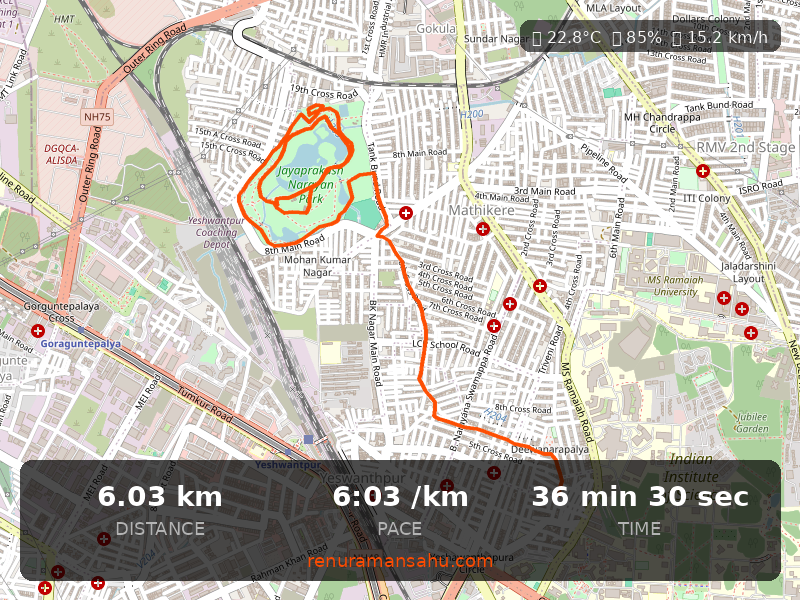
Run Snapshot
Raman covered 6.03 km at an average pace of 6:03/km, with a moving time of 36.5 minutes, on a morning run that started at 07:03 AM IST. The temperature was 22.8°C, with a humidity level of 85% and an Air Quality Index (AQI) of 26, indicating good air quality.

Pace & Effort Breakdown
The gap between Raman’s average pace of 6:03/km and max pace of 2:57/km reveals a pacing strategy that allows for significant variation in speed. Although heart rate data is not available, cadence data shows an average of 78.0 spm, which is below the optimal range of 170-185 spm, indicating potential for improvement in form efficiency. Given the temperature of 22.8°C, which is above 20°C, a pace slowdown of approximately 2-5% can be expected due to thermal stress. The dew point of 20.2°C may also impact evaporative cooling and breathing. The AQI of 26, estimated from atmospheric model, indicates negligible effect on performance, making it ideal for hard efforts.
Route Narrative
The run can be broken down into six segments, each with its unique characteristics. The first km was completed at an average pace of 8:09/km, with an elevation drop of 13.3m, and a cadence of 141 spm. The second km saw a slight improvement in pace to 7:56/km, with a smaller elevation drop of 4.0m, and a cadence of 139 spm. The third km was completed at a pace of 7:45/km, with an elevation drop of 7.0m, and a cadence of 146 spm. The pace significantly improved from the fourth km onwards, with average paces of 5:32/km, 5:27/km, and 5:25/km, respectively. The fastest segment was the sixth km, completed at a pace of 5:25/km, which can be attributed to the relatively flat terrain. The slowest segment was the first km, which may be due to the initial warm-up and the downhill terrain. The positive split in the first three km indicates a conservative start, while the negative split in the last three km suggests a strong finish.
Run Analysis
Workload Intelligence
The ACWR value of 1.79 falls into the danger zone, indicating a high injury risk. The acute load of 89.5 is significantly higher than the chronic load of 50.1, suggesting that Raman's current training load is above his average weekly load. At an ACWR of 1.79, the acute load of 89.5 sits above the chronic baseline of 50.1, indicating a potential for overreaching. The weekly run count of 3 and distance of 16.1 km in the last 7 days also suggest a high training load.

Physiological Impact
Based on the pace and duration of the run, it appears that Raman targeted his aerobic energy system. This session likely drove adaptations such as increased mitochondrial density, capillarization, and lactate clearance. The temperature and humidity levels may have added some thermal stress, but the good air quality mitigated any potential respiratory stress. The average pace of 6:03/km and moving time of 36.5 minutes justify the claim that this session targeted the aerobic energy system.
Recovery & Next Session
Given the high ACWR value and acute load, Raman should prioritize recovery and aim for at least 48 hours of rest or low-intensity training. The next workout should be a low-intensity run of 5 km, targeting a pace range of 6:30-7:00/km, to allow for active recovery and to reduce the risk of injury. This prescription is based on the current load data and the need to balance training with recovery.
Training Trajectory
The 28-day volume trend shows a significant increase in training load, which may not be safe. To avoid injury, Raman should aim to reduce his ACWR to below 1.5 and focus on consistent, moderate-intensity training. For the next 1-2 weeks, Raman should aim to maintain a weekly distance of 20-25 km, with a target pace range of 6:00-6:30/km, to allow for gradual progression and to reduce the risk of injury. A concrete coaching directive would be to target an ACWR of 1.2, with a weekly km goal of 22 km, and a pace target of 6:15/km.
View the original activity on Strava
Gear Used: Asics Novoblast 5 (Shoes)
Transparency: The links above are affiliate links — if you purchase through them, I earn a small commission at no extra cost to you. It helps support my training and this data analysis hobby project.